
Johnson County Court Records After a Jail Arrest
In Johnson County, an arrest rarely stays a simple police matter for long. Once a person is taken into custody and booked, the Johnson County State's Attorney reviews the case and decides which charges to file. That filing opens a criminal case, and the case becomes the court record that follows the arrest. The court record is kept by the Circuit Clerk and is separate from the arrest paperwork the sheriff or arresting agency holds. Johnson County sits in the First Judicial Circuit, part of the state's Fifth District, and its cases run through the courthouse in Vienna. Court records after an arrest show the charges as the prosecutor actually filed them, every hearing date, and the final outcome of each count.
The arrest side and the court side answer different questions. Booking and custody details, including where a person is held and the charges written at intake, sit on the jail side of the system; the Johnson County jail inmate records page covers that custody search, and booking photographs are handled on the jail roster mugshots page. The court record is the next step. It reflects the charges the State's Attorney chose to pursue, which can differ from what an officer alleged at booking. When people search for records after an arrest, they usually want this court file, because it is the one that tracks a case to a verdict, plea, or dismissal.
How to Find Johnson County Court Records After an Arrest
Court records after an arrest in Johnson County are searched through the online case portal and, when needed, directly with the Circuit Clerk. Illinois courts use Judici as the public case-search system, and Johnson County takes part. The First Judicial Circuit explains that court dates and case information can be found by selecting the correct county on Judici and searching by name or case number, or by contacting the Circuit Clerk's office. Arrest and booking details are not on the court portal. Those live on the jail side of the record.
The Judici landing page for Johnson County opens the gateway to local case records, as shown on the Judici Johnson County court portal.
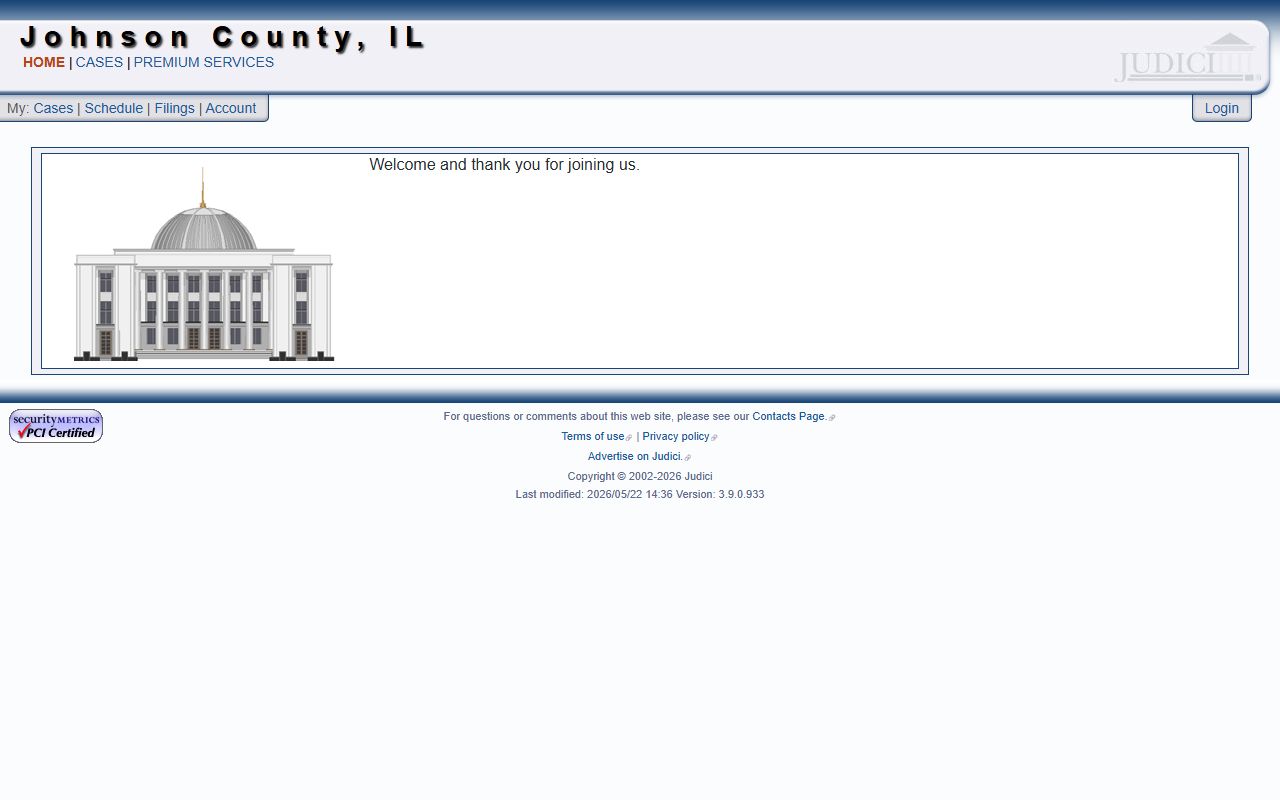
From that landing page a visitor moves into the case-search tool, picks the county, and runs a name or case-number search to pull the court record tied to an arrest.
- Open the Judici portal and select Johnson County, Illinois from the list of participating courts.
- Search by the defendant's name or, if you have it, the case number.
- Open the matching case and read the list of charges the prosecutor filed.
- Check each charge's statute, class, and current status, then review the court dates and any disposition entries.
The detailed Judici case search uses a human-verification step, so a search may ask you to confirm you are not a robot before results load. For documents that were filed electronically, Illinois also runs re:SearchIL through the eFileIL system. If a case does not appear online because it is older, sealed, juvenile, or not yet entered, the Circuit Clerk's office is the direct channel. Court files are not obtained through a Freedom of Information Act request to the courts; the Illinois Attorney General notes that the judicial branch is not subject to FOIA, so court records come from the clerk and the court portal instead.
How Charges Get Filed After an Arrest: Complaint, Information, and Indictment
The court record after an arrest begins with a charging document. Booking happens at the jail, but the formal charge starts when the prosecutor or a grand jury files paperwork that names the offense. Illinois uses three main charging instruments, and which one appears in a Johnson County case depends on how serious the charge is and how the State's Attorney chooses to proceed.
| Complaint | Information | Indictment | |
|---|---|---|---|
| Filed By | Officer / Prosecutor | Prosecutor | Grand Jury |
| Common For | Misdemeanors | Many felonies | Serious felonies |
| Starts | The case | The case | The case |
A complaint often supports a misdemeanor or the first charge right after an arrest. An information is the prosecutor's own sworn charge and is common for felonies. An indictment comes from a grand jury and is typical for the most serious felonies. Each one opens the same court case file, and the charges inside it can still change as the matter moves forward.
Johnson County cases are filed and stored at the courthouse in Vienna, pictured on the Illinois Courts Johnson County Courthouse directory page.
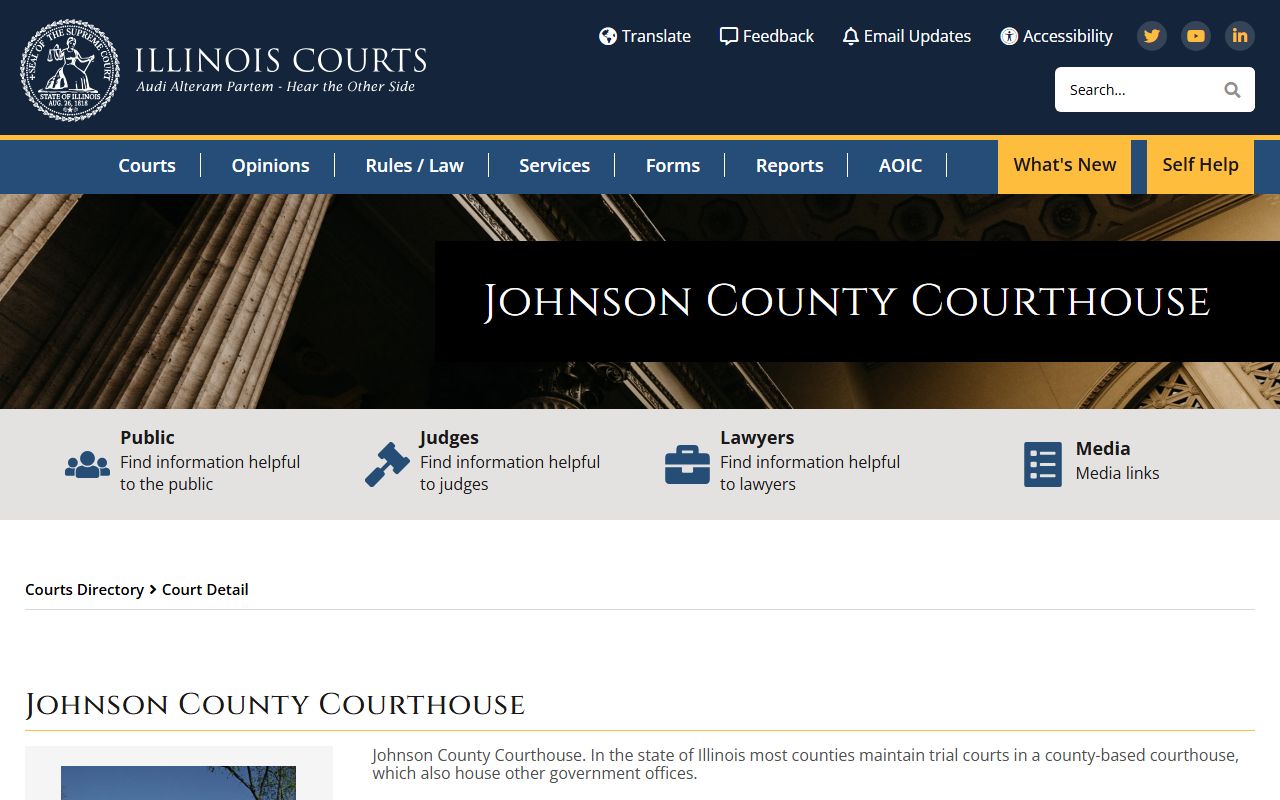
The Circuit Clerk's office inside that courthouse keeps the docket, the filings, and the dispositions that make up the court record after an arrest.
Charge Status and What It Means
Charges are not fixed once they are filed. As a Johnson County case moves through the court, the State's Attorney can amend, reduce, add, or drop counts, and a judge can dismiss them. This is why the charge written on a booking record can differ from the charge that finally appears in the court file. Reading the status of each count tells you where the case actually stands.
| Status | What It Means |
|---|---|
| Pending | The charge is filed and the case is still moving through the court. No final outcome has been entered yet. |
| Amended / Reduced | The prosecutor changed the charge, often to a different or lesser offense than the one filed at first. |
| Dismissed | The court ended the charge without a conviction, sometimes on a motion or for lack of evidence. |
| Nolle Prosequi | A formal notice that the prosecutor will not pursue the charge, which drops it without a conviction. |
Note: a booking charge reflects what an officer alleged at arrest, while the court record reflects what the prosecutor formally filed and how each count was finally resolved.
Pretrial Release and Detention After an Arrest
Illinois changed how release works after an arrest. Under the Pretrial Fairness Act framework, monetary bail was abolished as the ordinary way to get out of custody, so a Johnson County arrest no longer ends with paying a cash bond at the jail. Instead, the court decides release or detention at the first appearance. A prosecutor who wants to keep someone in custody must file a verified petition, and a judge holds a detention hearing before ordering pretrial detention. The court record shows these orders, and the result is found through the case file, not a bondsman.
| Release Status | How It Works |
|---|---|
| Pretrial Release | The court releases the person while the case is pending, the standard outcome for most charges after the change in Illinois law. |
| Release with Conditions | The court can attach conditions such as check-ins, no-contact orders, or supervision through statewide pretrial services. |
| Pretrial Detention | A judge may order a person held only after the State files a verified petition and the court makes the findings the statute requires. |
| Hold / Detainer | A person can stay in custody because of another warrant, a parole matter, or a request from another agency, even when the current case allows release. |
Statewide pretrial services help the Johnson County court supervise people released before trial, and release status can also be tracked through the Illinois VINE custody notification system. Because the detention facility for a Johnson County case may be a contracted jail, the case file and the court are the reliable record of release or detention, not a phone guess about a cash amount that no longer applies.
Warrants That Lead to an Arrest
A warrant is often what leads to an arrest in the first place, and the court record is usually the best place to confirm one. Illinois sets the requirements for arrest warrants and summonses by statute, and a warrant can come from a new charge or from a missed court date, which produces a bench warrant. Johnson County does not publish an official online active-warrant list in the sources reviewed, so the docket and the clerk become the practical place to look.
The First Judicial Circuit is direct about one point: warrant information cannot be disclosed over the phone. A reader who expects the clerk to confirm a warrant by calling will be turned away. The safer path is to check the court case record for the person's name, watch for warrant or bench-warrant entries on the docket, and speak with an attorney before appearing. A warrant arrest can open a brand-new booking event even when the underlying case is years old.
Important: the First Circuit states that warrant details are not given out by phone, so check the court case record or appear with counsel rather than relying on a call.
Charges vs. Convictions
Being arrested and charged is not the same as being convicted, and the court record keeps the two clearly apart. An arrest reflects probable cause, and a charge is an accusation the prosecutor must still prove. A conviction only happens after a guilty plea or a verdict that meets the high standard the law requires. The case file shows both the charge and, later, the disposition, so reading to the end of the record matters.
| Charge | Conviction | |
|---|---|---|
| Stage | Accusation | Verdict or plea |
| Burden of Proof | Probable cause | Beyond reasonable doubt |
| Public Record | Yes | Yes |
An open charge in a Johnson County court record is not proof of guilt. Until a disposition is entered, the case is pending, and a charge can still be reduced, dismissed, or dropped. Treating a charge as a conviction is one of the most common mistakes people make when they read a court record after an arrest.
Sealed vs. Expunged Court Records
Some court records after an arrest can be cleared. Illinois lets eligible cases be sealed or expunged, and the two are not the same. Sealing hides a record from most public view, while expungement removes or destroys it so it is treated as if it never happened. Eligibility depends on the charge, the outcome, and the waiting period set by state law.
| Sealed | Expunged | |
|---|---|---|
| Visibility | Hidden from public | Destroyed / treated as never existed |
| Law Enforcement | Limited access | Very limited |
| Eligibility | Many dispositions qualify after a waiting period; some offenses are excluded. | Generally arrests without conviction, acquittals, and dismissals. |
The Illinois expungement and sealing law spells out which records qualify, and the state courts publish standardized request forms. A dismissed or expunged case is the usual reason a charge that once appeared in a search later drops out of the public court record.
Background Check Considerations
Court records after an arrest often get pulled for background checks, but how the record is used carries legal weight. A casual name search on the court portal is not the same as a regulated background report. Employers, landlords, and others who use a consumer report to make decisions fall under the federal Fair Credit Reporting Act, which sets rules a court-portal search does not meet. An open charge, a dismissal, or a sealed case can all be misread by someone who treats raw court data as a finished report.
Important: this resource is not a consumer reporting agency under the Fair Credit Reporting Act, and Johnson County court records found here may not be used for employment, housing, credit, or other FCRA-covered screening.
Restricted Court Records After an Arrest in Johnson County
Not every court record after an arrest in Johnson County is open to the public. Juvenile cases are generally confidential, sealed and expunged matters are withheld, and some filings are restricted while an investigation is active. A case may also be missing from the online portal simply because it is old, was not yet entered, or is a type the court does not publish electronically. When a record does not show up, the absence is not proof that nothing exists. The Circuit Clerk is the office that can confirm what is on file and what is restricted.
Court records and arrest records also answer to different access rules. Court files come from the clerk and the case portal, while arrest and booking records from law enforcement follow the Illinois public-records process. Knowing which custodian holds the record keeps a search for court records after an arrest from stalling at the wrong office.